
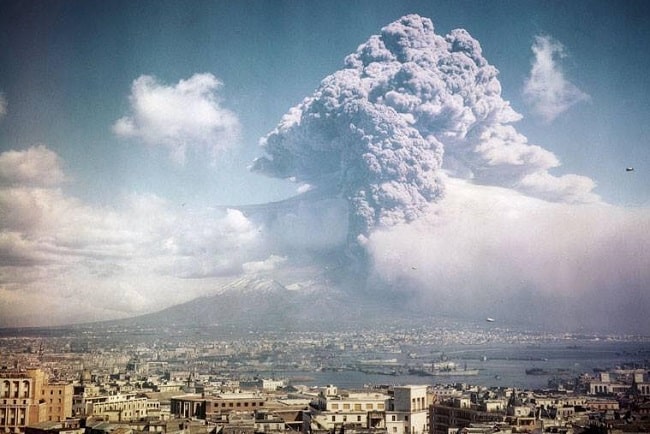
Mount Vesuvius erupted in March 1944, during the final stages of the Second World War in southern Italy. It was the volcano's most recent eruption and marked the end of a period of frequent activity that had continued for centuries.
The beginning of the eruption
The eruption began on 18 March 1944. Lava emerged from the crater and moved down the slopes, while explosions sent ash, lapilli and volcanic gases high above the volcano. The eruptive cloud was visible from Naples and from many towns around Mount Vesuvius.
Lava flows and affected towns
The most destructive lava flows reached the area of San Sebastiano al Vesuvio and Massa di Somma. Buildings, roads and cultivated land were damaged or buried. Other communities around the volcano were affected by falling ash and lapilli, and thousands of residents had to leave their homes.
Vesuvius during the Second World War
Allied forces were present in the Naples area at the time. Ash and volcanic debris damaged aircraft at nearby airfields and disrupted transport and military activity. Photographs and eyewitness accounts recorded the eruption, the advancing lava and the efforts of residents to protect their towns.
After 1944
The eruption gradually ended in early April. Since then, Mount Vesuvius has remained in a state of quiescence. The volcano is still active and is continuously monitored by the Vesuvius Observatory of the Italian National Institute of Geophysics and Volcanology.
The 1944 eruption remains an important event for understanding the recent history of Vesuvius and the volcanic risk faced by the densely populated area surrounding it.
