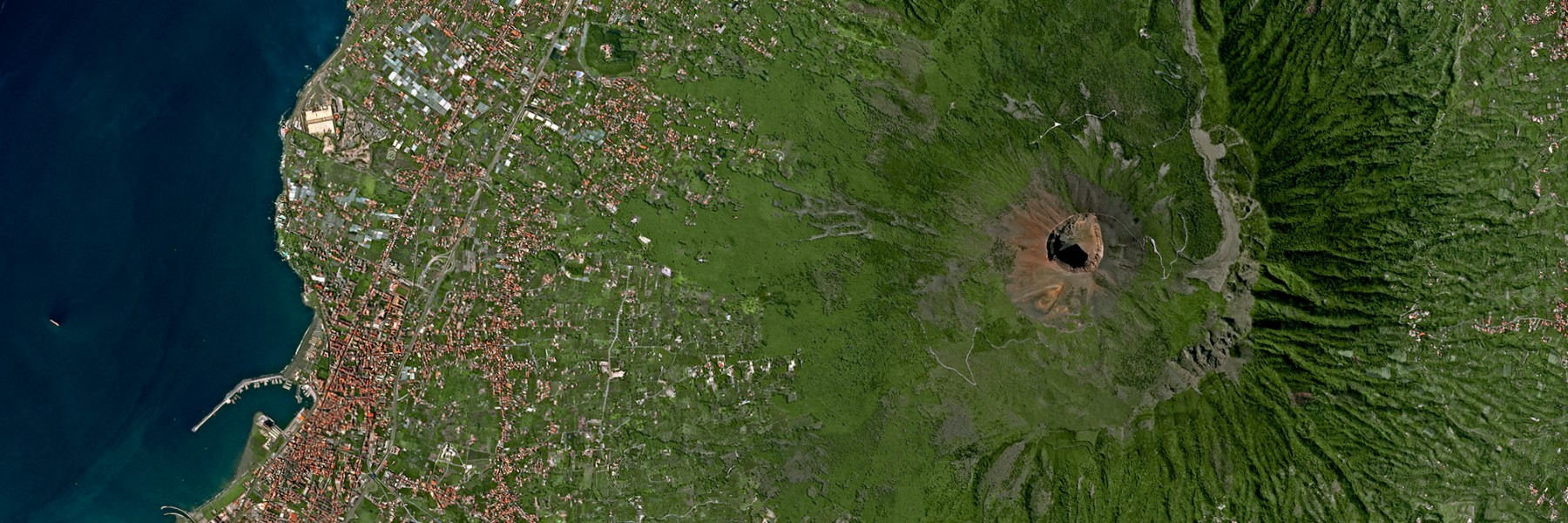

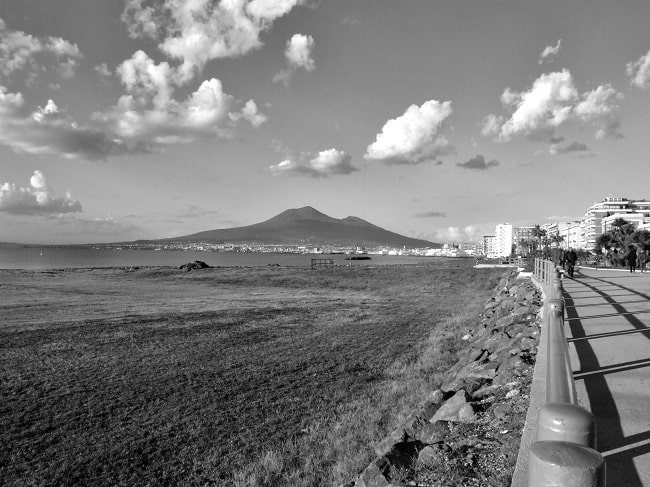
Mount Vesuvius is one of the world's best-known active volcanoes and the dominant natural landmark of the Bay of Naples.
Its history is inseparably linked with Pompeii and Herculaneum, the Roman cities buried during the famous eruption of AD 79, but the volcano itself has a much longer and more complex geological history.
What we commonly call Mount Vesuvius is actually part of the Somma-Vesuvius volcanic complex, formed by the older Mount Somma and the younger Great Cone of Vesuvius.
The Somma-Vesuvius volcanic complex
Mount Vesuvius is often imagined as a single volcanic cone, but its structure is more complex.
The volcano consists of:
-
Mount Somma, the remains of an older volcanic structure;
-
the Great Cone of Vesuvius, which developed inside the older caldera;
-
the Valle del Gigante, the depression separating the two structures.
Mount Somma surrounds the younger cone mainly on its northern side.
This distinctive structure is one of the most characteristic features of the Vesuvian landscape.
How high is Mount Vesuvius?
The highest point of Mount Vesuvius currently reaches approximately:
1,277 metres above sea level
The shape and height of the cone have changed repeatedly following eruptions, collapses and the accumulation of volcanic material.
The present crater is approximately:
-
450 metres in diameter;
-
300 metres deep.
These dimensions help explain why the crater appears so impressive when seen from the Great Cone trail.
Mount Somma
Mount Somma is the older part of the volcanic complex.
Its highest point, Punta Nasone, reaches approximately 1,132 metres above sea level.
The surviving ridge forms a large arc around the northern side of Vesuvius.
Deep valleys and erosion channels cut through its slopes, while forests cover large areas that contrast strongly with the darker and more recent volcanic landscape of the Great Cone.
The two main sectors of the depression between Mount Somma and Vesuvius are known as:
-
Atrio del Cavallo, to the west;
-
Valle dell'Inferno, to the east.
These areas preserve important evidence of past lava flows and volcanic activity.
How old is Mount Vesuvius?
The geological history of the area extends back hundreds of thousands of years.
Evidence of volcanic activity beneath the present Somma-Vesuvius complex dates back approximately 400,000 years, although the best-documented geological history relates mainly to the last 25,000 years.
Over this long period, repeated explosive eruptions partially destroyed the older Mount Somma volcano.
The younger cone of Vesuvius subsequently developed inside this older structure.
Explosive and effusive eruptions
Mount Vesuvius has produced very different types of eruptions.
Explosive eruptions
Explosive activity occurs when gas-rich magma fragments violently.
It can produce:
-
volcanic ash;
-
pumice;
-
lapilli;
-
volcanic bombs;
-
pyroclastic flows and surges.
The eruption of AD 79 is the most famous example.
Explosive eruptions can distribute volcanic material over large areas and generate extremely dangerous fast-moving currents of hot gas, ash and rock fragments.
Effusive eruptions
During other periods, Vesuvius has also produced lava flows.
The last eruption, in 1944, included important effusive activity and left lava fields that are still visible in parts of the National Park.
The history of Vesuvius therefore cannot be described simply as either explosive or effusive: the volcano has displayed a wide range of eruptive styles.
The eruption of AD 79
The most famous eruption of Mount Vesuvius occurred in AD 79.
A huge eruption column rose above the volcano, releasing ash and pumice into the atmosphere.
During the different phases of the eruption, volcanic material buried settlements around Vesuvius, including:
-
Pompeii;
-
Herculaneum;
-
Oplontis;
-
Stabiae.
Pompeii was covered mainly by falling pumice and ash before later pyroclastic currents reached the city.
Herculaneum was struck by extremely hot pyroclastic currents that rapidly buried the town.
The different processes explain why the two archaeological sites were preserved in different ways.
Pliny the Younger and the AD 79 eruption
One of the most important descriptions of an ancient volcanic eruption was written by Pliny the Younger.
He observed the eruption from across the Bay of Naples and later described it in letters to the historian Tacitus.
Pliny compared the enormous volcanic cloud to a pine tree, with a tall trunk spreading into branches at the top.
His description became so influential that large explosive eruptions of this type are now known as Plinian eruptions.
You can read the historical account here:
Letter of Pliny the Younger to Tacitus
Was the eruption really on 24 August?
The traditional date of the eruption is 24 August AD 79, based on surviving manuscript versions of Pliny's letters.
However, archaeological evidence discovered at Pompeii has led scholars to question this date.
Autumn fruits, clothing, coins and other evidence, together with an inscription discovered during recent excavations, have strengthened the possibility that the eruption occurred later in the year, probably in October AD 79.
For this reason, modern descriptions often refer simply to the eruption of AD 79 rather than presenting 24 August as an unquestioned date.
From AD 79 to 1631
The eruption of AD 79 did not mark the end of volcanic activity.
Vesuvius erupted several times during the following centuries.
The volcano then entered a relatively long period of reduced activity before a major new eruption occurred in 1631.
That eruption began a new period in the history of Vesuvius.
The eruption of 1631
On 16 December 1631, Vesuvius produced one of the most destructive eruptions in its recorded history.
Explosive activity, volcanic material, lahars and other phenomena affected communities around the volcano and caused extensive destruction.
The eruption marked the beginning of a new period of frequent activity that continued, with interruptions, for more than three centuries.
Eruptions between 1631 and 1944
Following the eruption of 1631, Vesuvius remained much more frequently active.
Important eruptions occurred in:
-
1794;
-
1822;
-
1872;
-
1906;
-
Each eruption modified the shape of the volcano.
The 1906 eruption was particularly powerful and substantially changed the summit area.
The final eruption occurred during the Second World War.
The last eruption: 1944
The most recent eruption of Mount Vesuvius began in March 1944.
Lava flows damaged several communities on the slopes of the volcano, particularly San Sebastiano al Vesuvio and Massa di Somma.
Ash and volcanic material affected a much wider area.
The eruption was observed and documented from the Vesuvius Observatory while southern Italy was still involved in the Second World War.
Since the end of the 1944 eruption, Vesuvius has not erupted again.
For a detailed historical account:
Is Mount Vesuvius still active?
Yes.
Mount Vesuvius is an active volcano, even though it has not erupted since 1944.
Its present condition is described as a period of quiescence or repose.
Activity currently includes:
-
low-level seismicity;
-
fumarolic activity;
-
circulation of hot fluids and gases within the volcanic system.
Small fumaroles can still be observed around parts of the Great Cone.
The absence of eruptions for several decades does not mean that Vesuvius is extinct.
How is Mount Vesuvius monitored?
Vesuvius is continuously monitored by the Vesuvius Observatory of the National Institute of Geophysics and Volcanology (INGV).
Scientists monitor parameters including:
-
earthquakes;
-
ground deformation;
-
volcanic gases;
-
temperature;
-
geochemical changes.
These measurements help identify changes in the behaviour of the volcanic system.
The historical Vesuvius Observatory on the slopes of the volcano was founded in the nineteenth century and was the world's first volcanological observatory.
Today monitoring is carried out using a modern network of scientific instruments.
Fumaroles at the crater
Visitors sometimes see small emissions of vapour around the crater.
These fumaroles are produced mainly by the circulation of water and gases through warm volcanic rocks.
Their presence is part of the normal current activity of the volcano and does not mean that an eruption is underway.
Scientific monitoring is necessary to distinguish normal variations from significant changes in volcanic activity.
Lava and pyroclastic deposits
The Vesuvian landscape preserves evidence of many different eruptions.
Lava
Lava flows form when magma reaches the surface and flows down the slopes.
Old lava fields can still be seen in several areas of Vesuvius National Park.
Pyroclastic material
Explosive eruptions produce fragmented volcanic material such as:
-
ash;
-
pumice;
-
lapilli;
-
volcanic bombs.
Large deposits from ancient eruptions can be seen throughout the Vesuvian area.
These volcanic materials have also contributed to the development of the fertile soils surrounding the volcano.
Vesuvius and the surrounding landscape
The volcanic complex rises above one of the most densely populated and historically important areas of southern Italy.
From its slopes and crater trail, visitors can see:
-
the Bay of Naples;
-
Naples;
-
Capri;
-
Ischia;
-
the Sorrento Peninsula;
-
the archaeological area of Pompeii;
-
the surrounding Vesuvian towns.
The contrast between the volcanic landscape, forests, cities and Mediterranean coastline makes Vesuvius unique.
Vesuvius National Park
Mount Vesuvius and Mount Somma are protected within Vesuvius National Park, established in 1995.
The Park protects not only the volcano itself but also:
-
volcanic landscapes;
-
forests;
-
wildlife;
-
native vegetation;
-
geological formations;
-
traditional agricultural areas.
The volcanic environment supports a surprisingly rich ecosystem.
Discover the Biodiversity of Vesuvius
Can you visit the crater?
Yes.
Visitors can walk to the rim of the Great Cone along Trail No. 5 – Gran Cono.
Access is regulated and requires a timed entrance ticket.
The trail starts from the visitor area at approximately 1,000 metres above sea level and continues uphill on volcanic terrain.
For practical information about tickets, clothing and the walk:
Mount Vesuvius Visitor Guide: What to Wear, Tickets & Tips
How to reach Mount Vesuvius
The Great Cone can be reached from Naples, Pompeii and Herculaneum using different combinations of trains, buses, shuttle services and organized tours.
Visitors arriving by car must also organize parking before reaching the upper visitor area.
Frequently Asked Questions
Is Mount Vesuvius an active volcano?
Yes. Vesuvius is active but currently in a period of quiescence.
When did Mount Vesuvius last erupt?
The most recent eruption occurred in March 1944.
How high is Mount Vesuvius?
Its highest point is approximately 1,277 metres above sea level.
How large is the crater?
The crater is approximately 450 metres in diameter and around 300 metres deep.
What is Mount Somma?
Mount Somma is the older volcanic structure surrounding the younger cone of Vesuvius mainly on its northern side.
What is the Somma-Vesuvius complex?
It is the complete volcanic system formed by Mount Somma and the younger Great Cone of Vesuvius.
Did Vesuvius destroy Pompeii?
Yes. The eruption of AD 79 buried Pompeii and also devastated Herculaneum, Oplontis and Stabiae.
Did lava bury Pompeii?
Pompeii was primarily buried by pumice, ash and later pyroclastic currents rather than by a lava flow.
When did the AD 79 eruption occur?
The traditional date is 24 August AD 79, but archaeological evidence suggests that the eruption may instead have occurred later in the autumn.
Is the volcano extinct?
No. Vesuvius remains an active volcano.
Why are there fumaroles at the crater?
They result from gases and water vapour circulating through warm parts of the volcanic system.
Is Mount Vesuvius monitored?
Yes. It is continuously monitored by the Vesuvius Observatory of INGV.
Can tourists visit the crater?
Yes. Visitors can access the Great Cone trail with a valid timed ticket, subject to weather and safety conditions.
Is Mount Vesuvius inside a national park?
Yes. Vesuvius National Park was established in 1995 and protects the volcanic complex and its surrounding natural environment.
